Showing posts with label Greece. Show all posts

Sunday, 28 October 2012

28 October 1940 - Greece in WWII

On this day in 1940, Mussolini's army, already occupying Albania, invades Greece in what will prove to be a disastrous military campaign for the Duce's forces.


Mussolini surprised everyone with this move against Greece; even his ally, Adolf Hitler, was caught off-guard, especially since the Duce had led Hitler to believe he had no such intention. Hitler denounced the move as a major strategic blunder. According to Hitler, Mussolini should have concentrated on North Africa, continuing the advance into Egypt. Even Mussolini's own chief of army staff found out about the invasion only after the fact. But despite being warned off an invasion of Greece by his own generals, despite the lack of preparedness on the part of his military, despite that it would mean getting bogged down in a mountainous country during the rainy season against an army willing to fight tooth and nail to defend its autonomy, Mussolini moved ahead out of sheer hubris, convinced he could defeat the Greeks in a matter of days. He also knew a secret, that millions of lire had been put aside to bribe Greek politicians and generals not to resist the Italian invasion. Whether the money ever made it past the Italian fascist agents delegated with the responsibility is unclear; if it did, it clearly made no difference whatsoever-the Greeks succeeded in pushing the Italian invaders back into Albania after just one week, and the Axis power spent the next three months fighting for its life in a defensive battle.  Mussolini had been humiliated by the Greeks.

Friday, 27 July 2012

Summer Holidays in Sifnos

I haven't been around a lot lately as business trips around the world and work have been keeping me busy for the last 6 months. Wintin 2 weeks I flew from Athens to Frankfurt, from there to New York and  L.A California, from L.A I flew back to Europe. In London I had a flight to catch to the Scandinavian countries. Then  back to Germany and from there to Sydney and later to Tokyo.

Since Wednesday here I am , at last,  back to Athens. Home sweet home! I mostly missed gyros and souvlaki and that unique athenian ambiaance which can be both....irritating and exciting. Right now, I'm taking a short holiday on my favourite Greek island - Sifnos.  I can't imagine spending a summer holiday away from Greece although I know there are a lot of beautiful places to enjoy summer worldwide. In Sifnos, I have made some great friends over the years, I enjoy fishing early in the morning,  even though I don't catch anything! I usually do, though! Calamari, red snapper or, if I'm lucky enough, red mullet and lobster! 


Sunday, 22 April 2012

Spring in Greece

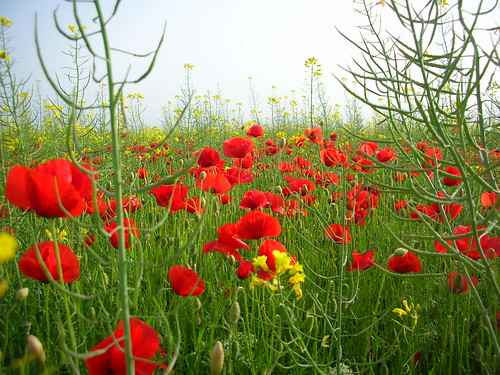
At this time of year, wildflowers are in full bloom all over Greece, the weather is pleasantly warm during the day but it can get rainy and stormy and quite chilly at night - especially in April. In May it often feels like summer, hot days are not unusual and we can expect temperatures around  23C / 74F


The refreshing season of spring adorns the fertile landscape of the country  with a synthesis of natural beauties that will take your breath away. The lush vegetation of the green forests and the verdant slopes of the brown-reddish mountains, the prosperous plains and the bloomed uplands, the flowered gardens and the flourished parks, shall be composing an amalgam of multiple colours and breathing the intoxicating essences of the efflorescent landscape, as the highlights of the golden sun are bedazzling your eyes.


Unquestionably, during the spring season, the enchanting landscape  of Greece is embellished in a unique manner, as the Greek land seems to have been covered with a multicolored veil and a refreshing essence. However, spring is not an invigorating season only for nature but even for us. As you l become an eyewitness of the revival of nature taking place while wandering around the appealing country of Greece, you can find numerous regions of absolute natural beauty interspersed all over the divine land.

Friday, 28 October 2011

28 October 1940

At 2:50 am on Sunday, 28 October 1940, General Ioannis Metaxas, Prime Minister of Greece , was awoken in his Athens home. At the door was the Italian Ambassador, Count Emmanuelle Grazzi, with a written ultimatum to the Greek government demanding that Italian forces be given free passage into Greece from Albania and that they be allowed to garrison certain unspecified "strategic points of Greek territory". Italy claimed that its request for this "temporary" occupation was the result of British attempts to involve more and more countries in the war. If Greece refused to comply then resistance would be "broken by force of arms". A reply was demanded by 6.00 am, but Metaxas gave it at once — "Alors c'est la guerre" (well, this means War, in French). At 5.30 am Italian troops crossed the Greek–Albanian border and Greece was at war with Fascist Italy.

The Italian Ultimatum:
"The Italian Government has repeatedly noted how, in the course of the present conflict, the Greek Government assumed & maintained an attidute which was contrary not only with that of formal, peaceful, good neighborly relations between two nations, but also with the precise duties which were incumbent on the Greek Government in view of its status as a neutral country. On various occasions the Italian Government has found it necessary to urge the Greek Government to observe these duties and to protest against their systematic violation, particularly serious since the Greek Government permitted its territorial water, its coasts and its ports to be used by the British fleet in the course of its war operations, aided in supplying the British air forces and permitted organization of a military information service in the Greek archipelago to Italy's damage.
The Greek Government was perfectly aware of these facts which several times formed the basis of diplomatic representations on the part of Italy to which the Greek Government, which should have taken consideration of the grave consequences of its attitude, failed to respond with any measure for the protection of its own neutrality, but, instead, intensified its activities favoring the British armed forces and its cooperaticn with Italy's enemies.
The Italian Government has proof that this co-operation was foreseen by the Greek Government and was regulated by understandings of a mllitary, naval and aeronautical character.
The Italian Government does not refer only to the British guarantee accepted by Greece as a part of the program of action against Italy's security but also to explicit, precise nengagements undertaken by the Greek Government to put at the disposal of powers at war with Italy important strategic positions on Greek territory, including air bases in Thessaly and Macedonia, designed for attack on Albanian territory.
In this connection the Italian Government must remind the Greek Government of the provocative activities carried out against the Albanian nation, together with the terroristic policy it has adopted toward the people of Ciamuria and the persistent efforts to create disorders beyond its frontiers.
For these reasons, also, the Italian Government has acceptedthe necessity, even though futilely, of calling the attention of the Greek Government to the inevitable consequences of its policy toward Italy. This no longer can be tolerated by Italy.
Greek neutrality has been tending continuously toward a mere shadow. Responsibility for this situation lies primarily on the shoulders of Great Britain and its aim to involve ever more countries in war.
But now it is obvious that the policy of the Greek Government has been and is directed toward transforming Greek territory, or, at least permitting Greek territory to be transformed, into a base for war operations against Italy.
This could only lead to armed conflict between Italy and Greece, which the Italian Government has every intention of avoiding.
The Italian Government, therefore, has reached the decision to ask the Greek Government, as a guaranty of Greek neutrality and as a guaranty of Italian security, for permission to occupy with its own armed forces several strategic points in Greek territory for the duration of the presert conflict with Great Britain.
The Italian Government asks the Greek Government not to oppose this occupation and not to obstruct the free passage of the troops carrying it out.
These troops do not come as enemies of the Greek people and the Italian Government does rot in any way intend that the temporary occupation of several strategic points, dictated by special necessities of a purely defensive character, should compromise Greek sovereignty and independence.
The Italian Government asks that the Greek Government give immediate orders to military authoritles that this occupation may take place in a peaceful manner. Wherever the Italian troops may meet resistance this resistance will be broken by armed force, and the Greek Government would have the responsibility for the resulting consequences"

Wednesday, 17 August 2011

Back from Sifnos


When you are on holiday, time flies. Ten days flew by in Sifnos without realising it. I went there alone but this did not prevent me from having a great time. I enjoy being my own company in the first place, doing whatever I want like swimming, fishing, sailing or  basking in the sun reading my favourite books. Secondly, I've made a few good friends there - all islanders - who won my heart from the very first day I set foot on Sifnos, 5 summers ago. Sifnos then was a very quiet island unlike most of the Cyclades. Only a few Athenians visited the island due to its proximity to Athens. Nowadays, Sifnos has become a very touristy island. Of course this is good for the islanders whose livelihood only depends on fishing and on tourism.


I spent most of the days fishing - I had a good catch! - then sailing to Sifnos' unspoilt beaches, meeting friends and, naturally, tasting for yet another summer the unique Sifnos traditional cooking.It is not accidental that Sifnos is the homeland of many great Greek chefs as for instance Nikos Tselemendes and Marcos. The traditional Sifnos cuisine cuisine is delicious and it includes dishes such as: chickpea croquettes, string beans with garlic paste, Sunday traditional chickpea soup, which is put in the oven on Saturday night and is cooked during the whole night with wood, caper-salad, meat cooked in the mastelo (traditional utensil made of potter’s clay). And fish, of course! Likecalamari, for instance.

Apart from giving birth to Dionysus, patron god of wine, Greece is the birthplace of the first VSOP wines in history. They were the wines of the islands of Chios and Thassos, renowned in the entire ancient world. Due to various historic and social reasons, as well as natural disasters, the art of wine-making was neglected from the middle of the nineteenth century until the early sixties. It was then that the ancient traditions of wine-making started being rediscovered and today, one can find many excellent Greek wines produced all over the country. When tasting Greek wine, bear in mind that it is a product of a distinctive environment and of grape varieties unknown to western wine lovers. Sifnos is no exception and produces some great wines,


My friend Manolis' reastaurant in Vathi is my favourite. The best clay oven food on the island. If you are lucky he may be roasting a lamb. Manolis has been the heart and soul of Vathi for decades. Though his son Stelios has taken over the runing of the restaurant, Manolis is always there acting as host and ambassador of kefi. A truly wonderful restaurant that should not be missed, particularly for a late and lingering lunch. Excellent wine from the barrel, baked foods from the oven, fried kalamari, whatever fish has been brought in, and the best Greek salads in all the Cyclades topped with arugula and mizithra, a Sifniot cheese less sharp then feta and the consistency of cottage cheese. When you are finished just jump right in the clean water of Vathi bay and then come back for a Greek coffee and baklava. If you decide that this is the life for you, then you can rent rooms right behind the restaurant, just like I did. (Manolis passed away in 2009 but his spirit lives on.)

So, how about you? Did you have a nice summer holiday? Where did you go? 

Wednesday, 10 August 2011

Summer Holidays

With the new recession in Greece  and a depression in Asian and European  markets yesterday (almost a black Tuesday), I shouldn't be taking a holiday at all! June and July were busier than ever before - hence all work and no play. It's not easy these days to be an economist and run your own business. Since June, people have been protesting all over Greece against the government's new austerity measures which are to me not only unreasonable but completely insane. The bottom line is that the average citizen will pay off our debt to Europe. No, this is not a joke!

Well, I was so tired and so exhausted that I promised myself to take a break. August 15, called Dekapentavgoustos in Greece, is like a second Easter to us. I can't imagine spending this important Greek holiday in any other place than Sifnos. This is an island I fell in love with many years ago, long before it started developping tourism.


Sifnos, lies in the middle of the Cyclades islands between Serifos, Kimolos and Antiparos and is about 80 nautical miles from Piraeus. It has an area of 74 sq. km. and a shoreline of 70 km, with a population of 2000. The island is reached on the ferries which run on the Piraeus- Kythnos- Serifos- Sifnos- Sifnos- Kimolos line, and there are also sailings to other islands in the Cyclades.

Sifnos was very wealthy in ancient times, thanks to its gold and silver mines. Proof of this, is the treasury which the Siphnians built at Delphi in the 6th century BC to house their offerings. However, it appears that something went wrong with the mines; either they were worked out or flooded by the sea -we do not know which- and their production ceased. In ancient times, Siphnos's wealth was measured by the gold and silver it produced, in the last two centuries it can be measured by its cultural output.


Tuesday, 14 June 2011

Flood Festival - Kataklysmos

A Greek Orthodox festival with strong pagan roots focusing primarily on water, Kataklysmos or Festival of the Flood marks the day of the Holy Spirit. Coastal cities make the most of the opportunity, staging concerts and games near the waterfront, but even inhabitants of inland towns and particularly children – their water guns a necessary accessory, enjoy a good ‘splash’. The feast of the Pentecost or Whitsun is marked 50 days after Greek Orthodox Easter. It is known also as the day of the Holy Spirit as it celebrates the descent of the Holy Ghost to the Apostles. In Cyprus, the celebrations also hark back to the Old Testament tale of Noah’s Ark, the Greek myth of Deukalion and ancient ceremonies in honour of Aphrodite and Adonis. Larnaka is particularly proud of the festivities it puts on for several days to celebrate Kataklysmos. The sea front promenade takes on the appearance of an open-air fair with scores of stalls selling toys and traditional food. Traditional culture takes pride of place with a competition for chatista or rhyming songs in the Cypriot dialect. Other performers include popular Greek and Cypriot singers and dance troupes. In line with the spirit of the celebrations, events include competitions in the water.

Tuesday, 6 July 2010

The Summer Effect: Happy July

I'm afraid I'm not much of a contributor as I was quite unable to cover for Constantinos these last two months. As per usual, May and June were quite hectic at the school as I had to organise final reviews, prepare final exam papers, mark them and issue end-of-year reports. But now it's the time to forget about work, at least for the next two months.
July is here with all the happy connotations of sun, sea, sand and , generally, a brighter mood. Since the end of June, I've been under the Summer effect doing things I haven't done in a long time such as water sports, spending time on the beach, tidying up my flat, my computer and my electronic home on TypePad or reading some unread books they had piled up.
July also marks the beginning of the sales which started earlier this year, probably because of the financial crisis. I haven't had time to go to the shops yet as the beach which is only 4km from home is much more alluring than a shopping spree. Yet, while lying on the beach the other day, I had time to look through the British issue of Harper's Bazaar. I love the new summer trends like the bright colours and patterns, the sophisticated swimwear or the long floral sun dresses.
July is probably the ideal time of year to spend a few days on a greek island where you can bask in the sun contemplating the infinite blue of the greek seas and feeling a world away from everything. Greece and the Greek Isles have always been my most favourite holiday destination and I have often fallen under their magic spell.
Have you ever been to the Greek islands? If not would you like to spend a holiday there? Which island would you choose and why? Can't wait to hear your views and - why not - your holiday experiences.
From Anastasia

Thursday, 25 March 2010

The Greek Revolution - 25 March 1821

Happy Greek Independence Day! Xronia polla se olous tous Ellines.

Wednesday, 24 February 2010

The Economic Crisis in Greece and Problems at Work

I know it's been quite some time now I haven't been around much but to be honest, problems at work are responsible for my long absence in blogging. As you may know, the economy in Greece was going from bad to worse and resulted in a serious economic crisis. When the global financial crisis struck, Greece was badly prepared. Hosting the expensive Olympic Games  in 2004 and failing to rein in its spiralling public debt, Greece is now in financial trouble. Help seems to be on the way in the form of a eurozone bailout and hopefully this will save Greece from total economic disaster.

However, many businesses including mine are severely affected and are threatened with bankruptcy. Neither the new Prime Minister nor the European Union will save my business. Only me. And I haven't fired anyone yet under the excuse of redundancy. As the Captain , I need to work 20 hours a day in order to steer my ship off "reefs". I also need to travel a lot for that all over Europe, so there's hardly any time left for blogging and commenting right now. My friend  Anastasia and my contributor on this blog will be replacing me in the next few weeks to come. She has her own blogs - three or four, I think - and a very limited free time, yet she didn't hesitate to tell me : "I'll make time for My Blog".  And I want to thank her from the bottom of my heart.

Wednesday, 28 October 2009

The Pride of OXI Day


By Gary Van Haas

The magnificent Greek holiday Oxi Day is celebrated every year in Greece on October 28th and mostly remembered for general Ioannis Metaxas' strong reply of 'oxi' (no) to Mussolini's request to allow Italian troops to come into Greece at the beginning of WW II. The result of this stern message was powerful, and in the end, helped to maintain Greece’s course of neutrality for generations to come. Nevertheless, the Italians did invade Greece, but were subsequently driven back into Albania.


The story begins in 1935, when King George II was restored to the Greek throne by a rigged plebiscite, where he made the right-wing general Ioannis Metaxas prime minister. Nine months later, Metaxas assumed dictatorial powers with the king’s consent under the pretext of preventing a communist-inspired republican coup. The October 28 national holiday also marks the date in 1940 when Greece entered WWII.

On that cherished day in Greek history, prime minister Ioannis Metaxas not only rejected Italy's ultimatum, he chose the road of resistance, and thus saved his reputation as a dictator. Cypriot countrymen also drew inspiration from Greece's refusal to let Italian troops invade in 1940 in the face of continued Turkish agression. For that matter, parades are also staged by Greek communities around the world in celebration of Oxi Day.

Today in Greece, celebrations of Oxi Day culminate in a large, lavish military parade down the main boulevards of Athens and Thessoloniki. Soldiers, tanks, armoured vehicles and students parade through most Greek cities with an air of pride, and politicans in reviewing stands have an opportunity to show their own spirit to Greece and the resistance and how in future generations it should it should be continued. For tourists and foreigners, it's a proud spectacle to behold, so if you're ever in Greece during that time, be sure and see it!

Sunday, 18 October 2009

Blog Action Day 2009 - Climate Change


I came across Blog Action Day 2009 - Climate Change on Anastasia's blog and thought I'd post some feedback as I happen to be very concerned about global warming and environmental issues, in general. As far as climate change is concerned in Greece, the future looks bleak.

1.The problem of parched land and drought will intensify and desertification will speed up.
2.Areas in seaside towns like Thessaloniki and Messolongi, will most likely find themselves under water.
3.The average annual temperature around the Mediterranean  increased by 1 degree Celsius compared with a 0.74 degree rise globally.
4. Greece's average rainfall in the past few years has fallen by about 30 percent since the mid 1970s. The month of January in 2007 was the driest in half a century while June 2008 was the hottest June on record, scientists have said.
5.Climate change is also affecting the flora and fauna of the country with migrating birds flying further north, citing a recent British study. Non-native viruses and diseases have also appeared.
6.The number of Greek forest fires will increase releasing even more carbon monoxide into the atmosphere .
This will have consequences to our health. Tourism will receive a blow.
7.The European Union's executive adopted plans  to cut greenhouse gas emissions, seeking to push the world into tough climate action.
8.Greece must meet its Kyoto (environmental) protocol targets diligently.The country must boost alternative energy production, increase investment in energy-saving measures and include climate change measures in every policy.

Climate change is a global problem in need of a global solution. This is why I believe that raising awareness is as important as ever before.

Sunday, 23 August 2009

Attica in Flames

Attica has been burning since yesterday and here in Athens we are all glued to the TV waiting for some good news but the winds make things worse. Many people have lost their homes, others are carried to the hospital because of breathing problems and there are those who refuse to leave their area hoping that they will save their properties. It seems that the fires are caused by arsonists. This is what angers me most. I am safe at the moment although I live very near the areas where the fires broke out. The weather forecast says that the winds will calm down tomorrow. Let's hope that tomorrow will be a better day and that all the fires will be under control.

Thursday, 20 August 2009

Back from the Holidays

All good things eventually come to an end! Although my summer holiday was much shorter than last year, I made time to forget all about work and personal worries and..recharge the batteries. I spent most of my holiday time in Mykonos, which is very unlike me as I hate the husltle and bustle of the island and I hate ..clubbing as well. Apart from its worldwide reputation of an island that never sleeps, Mykonos has also got its unique beauties. I stayed at a quiet hotel, near Ftelia - the best beach for windsurfing which is one of my favourite sports. Mykonos is also called the Island of the Winds and is ideal for the sport. After swimming and windsurfing, I had lunch at "Akri" - one of the best tavernas in the area of Ftelia at about 9 km from the Hora - the centre of Mykonos. The truth is, I only went to the centre once only to have dinner at Chez Maria but spent most of the evenings in my hotel room reading or listening to my favourite music. I went to bed early, before 11 pm and got up early to go swimming or windsurfing. Mykonos can be a very quiet place. It depends on what you are looking for. Now how about you? Did you have a nice holiday?

Tuesday, 28 April 2009

Galaxidi

galaxidi,greece Galaxidi is the prettiest of the low-key resorts on the north coast of the Gulf of Corinth. The town is graced with narrow cobblestone streets and two small harbours, and makes a pleasant base from which to visit Delphi. Galaxidi is reasonably tranquil except during summer and holiday weekends, when its charm is tested by car loads of Athenians. That's where I find refuge when I want to get away from the hustle and bustle of the city. I have a small cottage there overlooking the harbour and I really enjoy spending time there with friends and family or just by myself when I need some peace and quiet. I recently spent a week over the Greek easter there with the kids and some friends. galaxidi,greece The existence of Galaxidi dates since 1393 BC. The various events, the inscriptions,the finds, the graves intermingle with the legends and it is very difficult to disentangle them. The city was originally built 130 m above the sea, on a hill, near the location of today's church of St.Blasius and it was called Oianthi. This church was destroyed by an earthquake and it was rebuilt from preexisting old walls. All the surrounding area is an archeological site. The city was built two centuries before the Trojan war by Locros, a descendant of Defkalion. After his death a monument was erected to his honour by the Oianthians, called "the Locrion". In one Delphic inscription though it is written that the only sovereign was Armodamos. For a little while the city was also called Katakuzinoupolis, in 1444 A.D., from the name of Constantine Katakouzinos. Oianthi had signed at that time a treaty with the neighboring city of Horakion (Itea-Xeropigado) for peaceful coexistence and resolution of their differences, which proves the degree of civilization of the two cities. Oianthi was a nautical city and was connected with many cities by sea with which it had commercial and diplomatic relations. The regime was an authoritarian one, under a tyrant.Later on, the city of Galaxidi was founded by the sea and remained the main residence city of the people of Oianthi until today. In the beginning the people were living of piracy against enemy ships and caves were constructed to hide the ships in the location of Kavos and Potamaki. During the Peloponnesean War, Oianthi was an ally of Aitoloi and Philip,wanting to take revenge of Oianthians, declared war against them and conquered them. In the 3rd century B.C. Galaxidi became a nautical center and made alliances with other cities. Old texts found in Galaxidi talk about the nautical city with the marine history and heritage of the passion for the sea which until today remains a characteristic of all people of Galaxidi. Rigas Fereos' charta (map) in 1797 presents the name of Oianthi and Pentayi for today's Galaxidi. The presence of a small forest of pine trees, which are used in building ships, indicates the growing art of constructing means of marine transportation in Oianthi. The cultural growth of Galaxidi became quite evident after the independence about 1830 and remained until today with writers, painters, scientists who became known in Greece and abroad. Among them was Constantin Sathas, historian and writer who was born in 1842 and died in 1914. He conducted his research for 50 years in the biggest centers of his time: Venice, Piza, Florence, Genova, Paris. He published more than 20 books( in french), 75 papers which helped him in research of Greek history. France presented him with the golden metallion of the Academy for his distributions. Eva Vlami-Lekatsa is anoter famous writer from Galaxidi. She studied literature and music and became famous in the literary circles even in her first appearance as the writer Spyros Melas said. She was honored with the Ouranis award for the book "Skeletovrahos". galaxidi,greece The most recent writer from Galaxidi, Costoula Metropoulou, studied law and has written 11 books. She was awarded the Ouranis award for her book "Faces and Figures". In painting Spyros Vassiliou created his own school with his personal style. He studied in the Ecole des Beaux Arts and in 1930 was awarded from the Academy of Athens for his designs for the icons of the church of Saint Dennis in Athens. He published the book "Ships from Galaxidi", where beautiful pictures (mostly painted) of the ships are presented. The churches of Galaxidi were constructed before 1821.The biggest one St.Nickolas was rebuilt in 1827-1902. Its temple is well known throughout Greece as a masterpiece of sculpture in wood. The church of St.Paraskevi presents a simpicity and a mysterious atmosphere. It was built before 1821 and graves with roman tombstones were found in the churche's grounds. galaxidi,greece The church of St.John Prodromos was built before 1821 as well. It is very picturesque and it has an icon drawn by the Byzantine painter Michael Damaskinos in the 16th century showing the holy family.

Sunday, 19 April 2009

The Greek Easter

Today the Greek orthodox celebrated Easter called Holy Pascha. At midnight, Easter Martins and the Divine Liturgy are chanted. Our Lord's Glorious Resurrection services include The Resurrection Service. The church is lit by the candles of the faithful who receive the resurrection light and form a procession outside the church. The congregation hears the good news of Christ's triumph over death from the Gospel. The joyous hymn of Christ's resurrection is triumphantly chanted -"Christos Anesti Ek Nekron" - The Lord has risen from the dead The Pascha Liturgy and the Sermon of St John invite us to take part in the feast of the resurrection and to receive the Holy Communion.On Easter Sunday late morning we gather to celebrate the "Agapee" a Paschal vesper when we embrace and forgive our fellow Christians, sharing with others Christ's gift of new life. Then follows "to glendi" - the feast- during which we cook ovelias (lamb or goat on the skew) and kokoretsi consisting mainly of seasoned lamb or goat offal. Traditional Greek dances are performed all over Greece and we eat and dance and drink to our heart's content. Χριστός Ανέστη. Χρόνια Πολλά

Wednesday, 25 March 2009

Greek Independence Day

The celebration of Greek Independence Day on March 25th draws inspiration from one of the holiest days for Greek Orthodox Christians, the Annunciation of the Theotokos. This is the day that the Archangel Gabriel announced to Mary that she would bear a child. Bishop Germanos of Patras seized the opportunity by raising the banner of revolution, in an act of defiance against the Turks and marked the beginning of the War of Independence. Cries of Zito H Ellas (Long Live Greece) and Eleftheria H Thanatos (Freedom or Death) can still be heard today. These freedom fighters, or klephtes as they were called, of Greece sacrificed much for their country. Kolokotronis, Nikitara, Karaiskakis, Bouboulina, and Mpotsaris are some of the heroes of the Greek revolution. The struggle for independence was supported abroad by intellectuals of the day. In addition to the Secret Society of Friends (Filiki Eteria) and the Sacred Band (Ieros Lohos) prominent world figures including Lord Byron of England, Daniel Webster and Dr. Samuel Gridly Howe of the United States raised the interest level among Europeans and Americans. After centuries of unsuccessful uprisings and failure of the Ottoman Empire to assimilate and convert the Greeks, The War of Independence began in 1821 rising up against 400 years of occupation and oppression by the Ottoman Turks. The origin of the Turkish occupancy began in 1453 with the fall of Constantinople (currently referred to as Istanbul). All true and faithful Hellenes living in their occupied homeland reacted to the Turkish oppression and resisted the attempts to deprive the Greeks of their heritage, their freedom and their religion. During the dark years of the Ottoman occupation, thousands were killed and tortured for attending church or teaching their children the Greek culture, history and language. It was the Greek Orthodox Church that helped to retain their very identity by the institution of Crypha Scholia (Hidden Schools). These schools were secretely held in churches and a priest taught children their language, their history, their culture and their religion. For eight years the fighting ensued, until 1829, when the Sultan Mahmud II, facing Soviet troops at the gates of Constantinople, accepted Greek independence with the Treaty of Andrianople.
The flag of Greece has not changed since the revolution against the Ottoman Empire in 1821. The white cross in the upper left hand corner covering one fourth of the flag signifies the important role of the Greek Orthodox Church in the formation of the Hellenic Nation. The blue and white alternating stripes represent the sea and the relentless waves of the Aegean. According to legend, the Goddess of Beauty Aphrodite emerged from these waves. There are nine stripes representing each letter of the Greek word for freedom, Eleftheria.